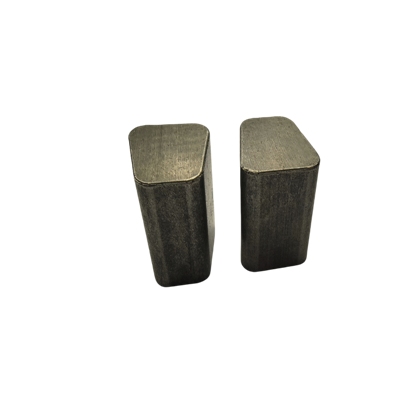
Phoenix Science and Technology News Beijing time on August 1st, Science Daily reported that according to a new theory proposed by researchers at the Massachusetts Institute of Technology in the United States, the magnetic refrigerator stickers gathered on the surface of the refrigerator could one day be used as a coolant. This theory describes the motion of magnons, which are quasiparticles of magnets and collective rotations of magnetic moments, or "spins." In addition to the magnetic moment, magnons also conduct heat. Using their proposed equation, the MIT researchers found that when exposed to magnetic field gradients, magnons may transfer from one end of a magnet to the other, carrying heat and creating a cooling effect. .
New theory predicts magnets could act as wireless coolants
"You can pump heat from one end to the other, so essentially you can use a magnet as a refrigerator," says Bolin Liao, a graduate student in MIT's School of Mechanical Engineering. "You can imagine the application scenario of wireless cooling, such as adding a magnetic field to a magnet one or two meters away from the computer to cool the computer."
In theory, the magnetic-field-powered refrigerator would require no moving parts, unlike conventional refrigerators, which require fluid to be drawn through a series of tubes for cooling. Liao and another graduate student, Jiawei Zhou, and Gang Chen, dean of MIT's School of Mechanical Engineering, published the paper on the theory of magneton cooling in the journal Physical Review Letters.
"Now people have a new theory to study how magnons move under coexisting fields and temperature gradients," Liao said. "These equations are fundamental to magnon transport."
cooling effect
In a ferromagnetic substance, localized magnetic moments can rotate and align in different directions. At absolute zero, the local magnetic moments align to create the strongest magnetic force in the magnet. As the temperature gradually increases, the magnet becomes weaker and weaker, as more and more localized magnetic moments rotate away from the alignment line, and the increasing temperature creates a magnetic subset.
Magnons are similar in many ways to electrons in that they both carry electricity and conduct heat. Electrons respond to electric fields or temperature gradients—a phenomenon known as the thermoelectric effect. In recent years scientists have investigated various applications of this effect, such as thermoelectric generators, which can convert heat directly into electricity, or achieve a cooling effect without any moving parts.
Liao and his colleagues identified a similar "coupling" effect in magnons that responds to two forces: temperature gradients or magnetic fields. Since magnons and electrons behave very similarly in this regard, the researchers proposed a theory of magnon transport based on the Boltzmann transport equation, a widely accepted electron transport equation in thermoelectrics.
Based on the derivation of this equation, Liao, Zhou and Chen proposed two new equations to describe magnon transport. Using these new equations, they predicted a new magnon cooling effect, similar to the thermoelectric cooling effect, in which magnons carry heat from one end of a magnet to the other under magnetic field gradients.
stimulate new experiments
Liao used the properties of common magnetic field insulators to model how the cooling effect of magnons works in existing magnetic field materials. He collected data on this material from previous literature, and then fed that data into the new model. They found that the material does indeed have a cooling effect for modest magnetic field gradients, which is very small but significant at low temperatures.
The theoretical results suggest that the first applications of magnon cooling effects could help scientists on projects that require wireless cooling at ultra-low temperatures. "At this stage, potential applications are cryogenics -- for example, cooling infrared detectors," Chen said. "However, we still need to experimentally demonstrate this effect and find better materials. We hope this will encourage new experiments."
The magnetic field cooling effect identified by the team is "an extremely useful theoretical framework for studying the coupling between rotation and heat, which can potentially stimulate the The concept of sub-use as a working 'fluid' in solid-state refrigeration systems." Shi was not involved in the study.
Liao points out that magnons could also be a new tool for improving existing thermoelectric engines, which, while innovative, are still relatively inefficient. "There is still a long way to go for thermoelectrics to compete with conventional technologies," Liao said. "Investigating magnetic field degrees of freedom can potentially optimize existing systems and improve thermoelectric efficiency."