Due to the advancement of science and technology in contemporary society, many high-tech products have been derived, such as computer hard drives, electric vehicles, magnetic levitation technology and other industries. Now sintered NdFeB magnets are widely used in these high-tech industries. Bad is very important to this product
How to judge the pros and cons of a product?
Z comprehensive judgment method: 1. Magnet coating; 2. Magnet performance; 3. Magnet size.
The guarantee of magnet performance comes from the control of raw material production process
1. In terms of magnetic field orientation, my country is the only country in the world that adopts two-step pressing. During orientation, it is formed by vertical pressing with small pressure, and then quasi-isostatic pressing is used. This is one of the most important features of my country's sintered NdFeB industry. one.
2. In addition, the monitoring of the quality of the production process is very important, which can be controlled by means of SC sheet thickness measurement and JM powder particle size distribution. High-quality products depend on the control of the production process, but customers will be very puzzled, how to judge the performance of the products I buy? China Institute of Metrology has successively developed various types of magnetic parameter measuring instruments for permanent magnet material technology. Pulsed Magnetic Field Magnetometer (PFM) is a test instrument for testing ultra-high coercivity permanent magnets, mainly to adapt to the high coercivity permanent magnets required in the field of electric vehicles and large permanent magnet motors.
3. According to the requirements of the enterprise to manufacture high-grade, mid-grade or low-grade sintered NdFeB, the raw materials are selected according to the raw material composition stipulated by the national standard.
4. Whether the production technology is advanced or not directly determines the performance and quality of the magnet. At present, the most advanced technologies are scale ingot (SC) technology, hydrogen crushing (HD) technology and jet mill (JM) technology. Small-capacity vacuum induction smelting furnaces (10kg, 25kg, 50kg) have been replaced by large-capacity (100kg, 200kg, 600kg, 800kg) vacuum induction furnaces. SC (StripCasting) fast-setting casting technology has gradually replaced large ingots (ingots with a thickness greater than 20-40mm in the cooling direction), and hydrogen crushing (HD) technology and jet mill (JM) have replaced jaw crushers and disc mills. Machine, ball mill (wet milling), to ensure the uniformity of the powder, and is conducive to liquid phase sintering and grain refinement.
Customers can choose the NdFeB grade they need according to the magnet parameters Br (remanent magnetism), Hcb (coercive force), Hcj (intrinsic coercive force), (BH) max (maximum magnetic energy product), and at the same time these four This parameter is the standard for judging whether the product is produced according to the customer's requirements. The guarantee of magnet size depends on the processing strength of the factory
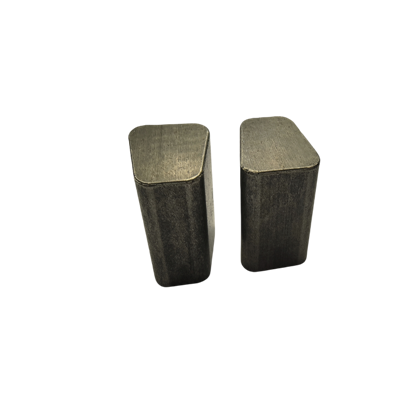
The shapes of NdFeB permanent magnets used in practice are various, such as disc, cylinder, cylinder (with inner hole); square, square, square column; tile, fan, trapezoid, polygon and various irregular shapes, etc. The permanent magnets of each shape have different sizes, and it is difficult to do one molding in the production process. The general production process is: first produce large (large size) blanks, after sintering and tempering, and then through machining (including cutting, drilling) and grinding, surface coating (coating) treatment, and then carry out Inspection of magnet performance, surface quality and dimensional accuracy, followed by magnetization, packaging and delivery.
1. The surface of sintered NdFeB permanent magnet components generally requires smoothness and certain precision, and the surface of the magnet delivered from the blank needs to be surface-ground. The commonly used grinding methods for square NdFeB permanent magnet alloys include plane grinding, double-end grinding, internal grinding, and external grinding. Cylinders are commonly used for coreless grinding and double-end grinding. Tile, sector and VCM magnets use a multi-station grinder.
A qualified magnet not only needs to meet the performance standards, but also the control of dimensional tolerances directly affects its application. The guarantee of size directly depends on the processing strength of the factory. The processing equipment is constantly updated with the economic and market demand. More efficient equipment and the trend of industrial automation not only meet the increasing demand of customers for product accuracy, but also It saves manpower and costs and makes it more competitive in the market.
2. Processing is divided into three categories:
(1) Cutting process: cutting cylindrical and square cylindrical magnets into discs and squares;
(2) Shape processing: processing round and square magnets into fan-shaped, tile-shaped or magnets with grooves or other complex shapes;
(3) Punching processing: The round bar and square bar magnets are processed into cylindrical or square cylindrical magnets. The processing methods are: grinding and slicing, EDM and laser processing.