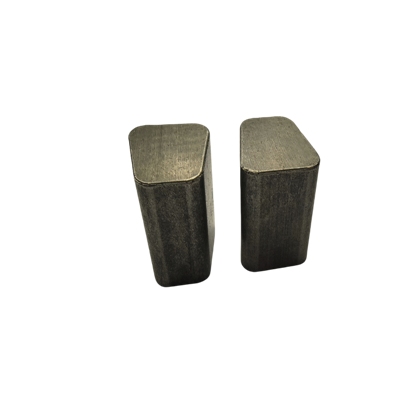
The characteristics of the powder core are as follows:
Magnetic powder core
The magnetic powder core is a kind of soft magnetic material made by mixing ferromagnetic powder and insulating medium. Since the ferromagnetic particles are very small (0.5 to 5 microns used at high frequencies) and are separated by non-magnetic electrical insulating film materials, on the one hand, eddy currents can be isolated, and the material is suitable for higher frequencies; on the other hand, due to the particles The gap effect between the two leads to the material with low magnetic permeability and constant magnetic permeability; and because the particle size is small, the skin phenomenon basically does not occur, and the change of magnetic permeability with frequency is relatively stable. Mainly used for high frequency inductors. The magnetoelectric performance of the magnetic powder core mainly depends on the magnetic permeability of the powder material, the size and shape of the powder, their filling factor, the content of the insulating medium, the molding pressure and the heat treatment process.
Commonly used magnetic powder cores are iron powder cores, permalloy powder cores and iron-silicon-aluminum powder cores.
The calculation formula of the effective permeability μe and inductance of the magnetic core is: μe = DL/4N2S × 109
Among them: D is the average diameter of the magnetic core (cm), L is the inductance (share), N is the number of winding turns, and S is the effective cross-sectional area of the magnetic core (cm2).
Iron powder core
Commonly used iron powder cores are composed of carbon-based ferromagnetic powder and resin carbon-based ferromagnetic powder. Lowest price among powder cores. The saturation magnetic induction value is around 1.4T; the permeability ranges from 22 to 100; the initial permeability μi has good stability with frequency changes; the DC current superposition performance is good; but the loss is high at high frequencies.
Permalloy powder core
Permalloy powder cores mainly include molybdenum permalloy powder cores (MPP) and high magnetic flux powder cores (High Flux).
MPP
It is composed of 81% Ni, 2% Mo and Fe powder. The main features are: the saturation magnetic induction intensity value is about 7500Gs; the magnetic permeability range is large, from 14 to 550; it has the lowest loss in the powder magnetic core; excellent temperature stability, widely used in space equipment, outdoor equipment, etc.; magnetic The stretching coefficient is close to zero, and no noise is generated when working at different frequencies. Mainly used in high quality factor Q filters below 300kHz, inductive load coils, resonant circuits, commonly used in LC circuits with high temperature stability requirements, output inductors, power factor compensation circuits, etc.
It is commonly used in AC circuits, and the powder core is the most expensive.
The high magnetic flux powder core HF is composed of 50% Ni and 50% Fe powder. The main features are: the saturation magnetic induction intensity value is around 15000Gs; the magnetic permeability ranges from 14 to 160; it has the highest magnetic induction intensity and the highest DC bias capability among the powder magnetic cores; the magnetic core is small in size. It is mainly used in line filters, AC inductors, output inductors, power factor correction circuits, etc. It is commonly used in DC circuits, and is mostly used in high DC bias, high DC and low AC. Price is lower than MPP.
Kool Mμ Cores
The FeSiAl powder core is composed of 6%Al, 9%Si, 85%Fe powder. It is mainly used to replace the iron powder core, the loss is 80% lower than the iron powder core, and can be used at frequencies above 8kHz; the saturation magnetic induction is about 1.05T; the magnetic permeability is from 26 to 125; the magnetostriction coefficient is close to 0, at different frequencies No noise when working under high pressure; higher DC bias capability than MPP; best cost performance. Mainly used in AC inductors, output inductors, line filters, power factor correction circuits, etc. Sometimes it is also used as a transformer core instead of air-gap ferrite.