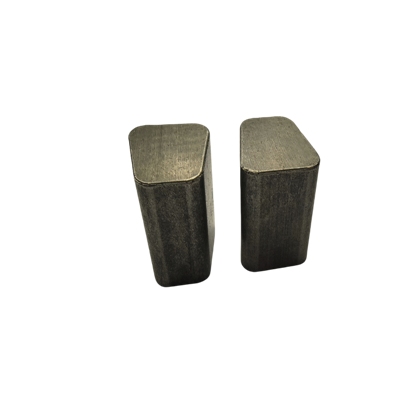
Composite soft magnetic material (SMC) is a new type of soft magnetic material prepared by powder metallurgy technology based on high-purity iron powder as raw material, heat treatment after surface insulation and pressing. SMC composite soft magnets have high saturation magnetic induction and low high-frequency eddy current loss, and can be processed into complex three-dimensional (3D) shapes and have complex magnetic circuits. The use of SMC materials can reduce the size of motors, increase power, save wires, and simplify assembly. In the future, it is expected to replace or replace laminated materials (such as steel sheets, etc.) as the mainstream soft magnetic materials for motors.
Magnetic permeability: The physical quantity that characterizes the magnetic permeability of a material, u=B/H, is closely related to the working state of the device, and depends on the purity, density and particle size of the material. The higher the purity of the material, the higher the density and the smaller the particle size. The thicker it is, the higher its magnetic permeability.
Although the magnetic permeability of SMC iron core is much lower than that of silicon steel sheet, the effective magnetic permeability in the magnetic circuit is equivalent, and the effective magnetic permeability is determined by the air gap.
Calculation formula: ue=(L+lg)/(L/ui+lg)
In the formula, ue is the effective magnetic permeability of the iron core, the magnetic permeability of the iron core is ui, the internal magnetic path length of the iron core is L, the air gap magnetic permeability is 1, and the air gap magnetic path length is lg. Once the magnetic circuit is set, L and lg are fixed, and the ui varies with different materials, but the ue has little difference.