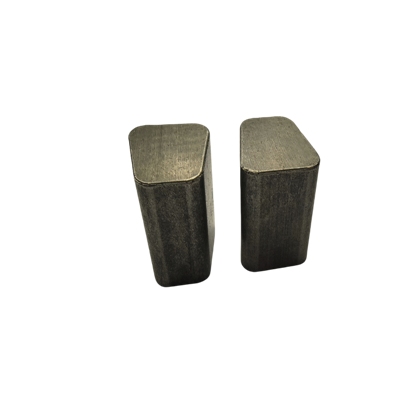
What motors use magnets? Where are the magnets in the motor located ?
DC motor (DC motor)
Because the coil current needs to be reversed in an ordinary DC motor, the magnet can only be made into a stator to allow the coil to rotate. The structure of the DC motor should be composed of two parts: the stator and the rotor. The stationary part of the DC motor when it is running is called the stator. The main function of the stator is to generate a magnetic field. It consists of a base, main magnetic pole, commutating pole, end cover, bearing and brush device. The rotating part is called the rotor. Its main function is to generate electromagnetic torque and induced electromotive force. It is the hub for energy conversion of the DC motor, so it is usually called the armature. It consists of the rotating shaft, armature core, armature winding, and commutator. and fans.


Brushless DC motor (BLDC motor)
Brushless DC motors usually consist of a stator and a rotor. The stator is usually composed of permanent magnets and coils, and the rotor is composed of permanent magnets or electromagnets .
Since the brushless DC motor does not have a mechanical commutator, the coil is made into the stator and the magnet is made into the rotor. Installation method of permanent magnet brushless motor rotor magnets: Rotor magnets generally have cylindrical, rhombus, tile, rectangular, etc.
The rotor core is designed according to different needs. Whether the rotor magnets are surface-mounted or embedded, special equipment is required to complete the loading of magnets. When the quantity is large, manual methods are unrealistic, inefficient, and easy to hurt your hands. Therefore, magnetic steel filling equipment is generally used. According to different rotors, corresponding magnet steel filling equipment is designed to ensure that the magnet steel can be quickly filled once or multiple times, which can adapt to fast delivery.


AC motor (AC motor)
There are no magnets in the AC motor, and the current in the coil is naturally commutated, so the coil can be used as either a stator or a rotor.

Stepper motor
According to the structure of stepper motors, they can be divided into three types: permanent magnet type, reactive type and hybrid type. The most commonly used stepper motor at present is the hybrid stepper motor, because it combines the advantages of the permanent magnet type and the reactive type.
1.Permanent Magnet (PM)
The rotor is made of permanent magnet materials. The permanent magnet materials used according to the power of the stepper motor include bonded NdFeB and sintered NdFeB magnets.
2.Reactive principle (Variable Reluctance, VR)
The rotor is made of soft materials (usually silicon steel sheets or electrical pure iron rods and other magnets). There are multiple salient poles on the rotor. In this way, when the coil is energized, it will attract the rotor to rotate, causing the magnetic field in the magnetic circuit to rotate. Minimal resistance. The tooth slots of the rotor produce reluctance changes when rotating, so it is also called a variable reluctance motor. Reactive stepper motors do not use permanent magnets.
3.Hybrid Stepping (HS)
The name of the hybrid stepper motor comes from its rotor structure, which is a composite of a PM rotor and a VR rotor. Hybrid stepper motors have a permanent magnet on the rotor.

Servo motor
Servo motors usually consist of the motor itself, a reducer and an encoder. The motor itself can be a DC motor or an AC motor. The reducer can appropriately reduce the output torque and speed of the motor. The encoder can feedback the angular position of the motor in real time, and can achieve precise control and positioning by controlling the output of the motor. The servo motor is mainly composed of a stator and a rotor. There are two windings on the stator, the field winding and the control winding. The internal rotor is made of permanent magnets or induction coils, magnetically conductive materials, and the rotor rotates under the action of the rotating magnetic field generated by the excitation winding. At the same time, the servo motor has its own encoder, and the driver receives the feedback signal from the encoder in real time, and then adjusts the rotor rotation angle based on comparing the feedback value with the target value. It can be seen that the control accuracy of the servo motor is largely determined by the accuracy of the encoder.


Induction motor
Induction motor is also called "asynchronous motor", that is, the rotor is placed in a rotating magnetic field. Under the action of the rotating magnetic field, a rotational torque is obtained, so the rotor rotates. The rotor is a rotatable conductor, usually in the shape of a squirrel cage. The stator is the non-rotating part of the motor and its main task is to generate a rotating magnetic field. Rotating magnetic fields are not achieved mechanically. Instead, alternating current is passed through several pairs of electromagnets to cause the properties of their magnetic poles to change cyclically, so it is equivalent to a rotating magnetic field. No permanent magnets are used in induction motors.

Series motor
Single-phase series motors are commonly known as series motors or universal motors. They are mainly composed of stator, rotor and bracket. The stator is composed of salient pole core and field winding. The rotor is composed of hidden pole core, armature winding and commutator. It consists of a deflector and a rotating shaft. A series circuit is formed between the field winding and the armature winding through brushes and commutators. Permanent magnets are not used in series motors.


Synchronous motor
As the name suggests, a synchronous motor is capable of running at a constant speed regardless of the load acting on it. The rotor is excited by a DC power supply, and the magnetic field generated by the DC excitation around the rotor coil is as shown below. Apparently, due to this magnetic field, the rotor acts like a permanent magnet. The rotor can also be made of permanent magnets. In a permanent magnet synchronous motor, the rotor is composed of permanent magnets.

Asynchronous motor
Asynchronous motors are divided into two forms according to the rotor structure: squirrel cage type (squirrel cage asynchronous motor) and wound type asynchronous motor. Asynchronous motor for motor operation. Because the rotor winding current is generated by induction, it is also called an induction motor. Asynchronous motors are the most widely used and most in demand among all types of motors. In an asynchronous motor, the stator supplies alternating current to generate a rotating magnetic field, and the rotor is induced to generate a magnetic field.
In this way, the two magnetic fields interact to cause the rotor to rotate following the rotating magnetic field of the stator. The rotor rotates the magnetic field slower than the stator, has a slip, and is not synchronized, so it is called an asynchronous machine. Asynchronous motors do not use permanent magnets.

Shaded pole motor
Shaded Pole Motor, also called Shaded Pole Motor, is a type of single-phase AC motor. It usually uses a cage-shaped chute cast aluminum rotor. Shaded pole motors are divided into salient pole shaded pole motors and hidden pole shaded pole motors. Generally used in small-capacity occasions such as no-load or light-load starting, such as electric fans, electric models, etc. Because it is an AC motor, there are no permanent magnets in the stator or rotor of the shaded pole motor.

Claw pole motor
Traditional permanent magnet claw pole motor, two stator cores cooperate axially left and right to form a permanent magnet synchronous motor with claw-shaped magnetic poles . With the development of technology, claw pole motors have also developed electric excitation claw pole motors and hybrid excitation claw pole motors.

Linear Motor
There are three common forms of linear motors: U-shaped, flat, and tubular, also called air-core linear motors, iron-core linear motors, and shaft-type linear motors (cylindrical linear motors).
1.Flat linear motors are used in single-axis motion platforms. The magnet assembly is fixed and the coil assembly drives the upper plate to move.

2. U-shaped linear motors , iron-core U-shaped linear motors are used in X, Y motion platforms . U-shaped linear motors have two opposite parallel magnetic tracks. The coils are wrapped in epoxy resin and act as power generators. The coil components are ironless. The iron core needs to be supported in the magnetic track through bearings to move back and forth.
Because the coil assembly has no iron core , there is no attraction or interference between it and the magnetic track. This coil assembly is very light and can achieve high acceleration.

3. Schematic diagram of a shaft linear motor: In the middle is a shaft containing a ring magnet assembly. The coil is cylindrical and surrounded by the shaft. The two can move relative to each other in the axial direction. Some shaft motors have guide rails and some do not. This design provides an alternative to cylinder or lead screw isoaxial drives. Shaft linear motors are used in single-axis motion platforms, driven by dual motors. Both ends of the motor shaft are fixed, the coil assembly moves, the grating ruler and the degree head are arranged in the center, and the guide rails are distributed on both sides of the grating ruler.

Disc motor
The magnetic field direction of an ordinary motor diverges in the radial direction, while the magnetic field direction of a disk motor is parallel to the rotating axis. Therefore, the disc motor is also called an axial magnetic field motor. The magnetic field travels from the axial direction, which not only has a high magnetic energy density, but also a large space for energy exchange. Therefore, the torque density of the motor is significantly higher than that of the radial magnetic field. The stator of the disc motor usually uses SMC composite soft magnetic material, while the rotor part uses sintered NdFeB powerful magnets.