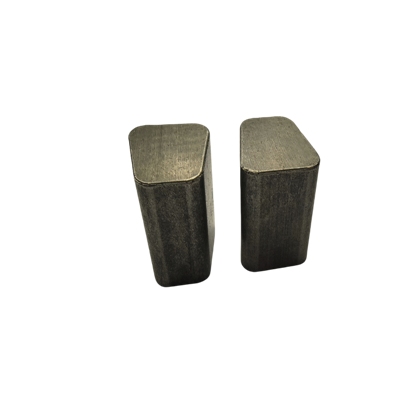
What is a magnetic transmission coupling ?
Magnetic transmission coupling definition:
The magnetic coupling is a new type of coupling that connects the prime mover and the working machine through the magnetic force of permanent magnets. It does not require direct mechanical connection, but uses the interaction between rare earth permanent magnets.
The magnetic field can penetrate a certain The spatial distance and the characteristics of the material are used to transmit mechanical energy. The emergence of magnetic couplings has completely solved the leakage problem of dynamic seals in some mechanical devices.
Magnetic transmission coupling types:
Common magnetic transmissions include three types: synchronous transmission (planar type and coaxial type), hysteresis transmission and eddy current transmission. Due to their respective characteristics, they are used in different fields.
1.Synchronous transmission (planar and coaxial types)
Planar magnetic transmission coupling : the magnet is magnetized in the axial direction, and the coupled magnetic poles are arranged in the axial direction ;
Coaxial magnetic transmission coupling : the magnet is magnetized in a radial direction, and the coupled magnetic poles are arranged in a radial direction ;

2.hysteresis drive
Hysteresis transmission is a method of transmission using the hysteresis principle.
Common hysteresis actuators are generally coaxial structures similar to synchronous actuators. The difference is that the inner and outer rotors use different magnetic materials. Generally speaking, the inner rotor (drive shaft) uses materials with high coercivity and high remanence, such as neodymium iron boron.
The outer rotor (driven shaft) is made of low-coercive magnetic material, such as alnico. The magnets on the driving shaft are arranged crosswise according to the NS pole. When the load is not greater than the rated torque, the driven shaft rotates synchronously with the driving shaft; when the load exceeds the rated value, the inner and outer rotors slip and only the rated torque is transmitted to the driven shaft. The excess energy is released in the form of heat during the charging and demagnetizing process of the inner magnet to the outer magnet.
Hysteresis actuators are available in fixed torque types and adjustable torque types. The former has an unadjustable torque and is equivalent to a transmission with overload protection; the latter has an adjustable torque and is generally used in the retracting and unwinding structure to control the tensioning force during the retracting and unwinding process. In addition, this hysteresis transmission structure can also be seen in the capping mechanism, that is, the magnetic capping device, which ensures that the bottle cap receives sufficient tightening force without damaging the bottle cap or other mechanical structures.
The same function can be obtained by using springs and friction plates. However, relatively speaking, there is no direct friction in hysteresis transmission components, and excess energy is dissipated in the form of heat. It has the advantages of simpler maintenance and no dust generation.

3.Eddy current transmission
Eddy current transmission can be achieved by replacing the permanent magnet material in the driven part of any of the above-mentioned actuators with non-ferromagnetic materials with good electrical conductivity, such as copper and aluminum materials, although the transmission efficiency is not necessarily very high. On the active disk, high-performance magnets are installed in an NS cross pattern. The driven disk is made of copper material with good electrical conductivity. Magnetic field lines pass through the copper disk. The driving disc rotates, and the eddy current drives the driven copper disc to follow. Eddy current transmission can be in two states: synchronous or asynchronous.
To be precise, synchronous eddy current drives generally have a small amount (5%) of asynchrony. For example, input 1000rpm and output 950rpm. This desynchronization can be accepted as a transmission loss.