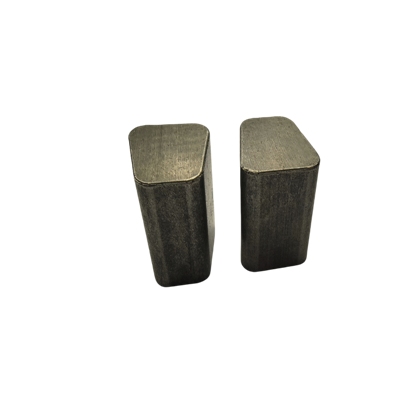
What is eddy current loss?
When the alternating current passes through the wire, the distribution of the current density on the cross-section of the wire is uneven. With the increase of the frequency of the current change, the current is more and more concentrated on the surface of the wire, and the current inside the wire is getting smaller and smaller. The phenomenon is called the skin effect.
The cause of the skin effect is eddy currents. From the law of electromagnetic induction, it can be seen that an alternating magnetic field will be generated around an alternating electric field. When an alternating current passes through a conductor, an alternating magnetic field will be generated inside and around the conductor, causing a vortex-shaped induced current to be generated inside the conductor. The eddy current is referred to as eddy current.
Disadvantages of eddy current loss
1. Lost energy, reducing the efficiency of electrical equipment,
2. Lead to temperature rise of electrical equipment.
3. Cause the temperature of the magnet to rise and the attenuation of the magnetic field.
In which structures do eddy current losses occur?
Stator and rotor of rotating machinery. In other words, the iron core and magnets of our motor. It is true that not only iron cores but also magnets produce eddy current losses, but we usually don't pay much attention to the eddy current losses of magnets. The size of the eddy current loss is related to factors such as the change mode of the magnetic field, the motion of the magnet, the shape of the magnet, the permeability and the resistivity.
How to reduce the eddy current loss of the motor?
Conventional methods to reduce the eddy current loss of the iron core:
1. Use a single thinner silicon steel sheets (0.5, 0.3, 0.2, 0.1mm)
2. Use SMC composite soft magnetic material.
3. Use the iron core of amorphous material.
Conventional methods for reducing eddy current loss of magnets:
1. A shielding post surrounding the magnet
2. Split magnet
3. Side isolation magnets.
4. Use bonded magnets with high resistivity or increase the resistivity of sintered magnets.