1. Differences in ingredients
In NdFeB permanent magnets, the rare earth metal neodymium accounts for about 29%~32.5%, the metal element iron accounts for 64%~69%, the non-metal element boron accounts for 1.1%~1.2%, and a small amount of dysprosium, terbium, niobium, copper, etc. are added. element. For samarium cobalt magnets, taking the 2:17 type as an example, the rare earth metal samarium accounts for 23%~28%, metal cobalt accounts for 48%~52%, metal element iron accounts for 14%~17%, and a small amount of copper, zirconium and other elements.
2. Magnetic strength
The maximum magnetic energy product of NdFeB magnets is N52, while the maximum magnetic energy product of SmCo NdFeB magnets is 32M. It can also be seen from this that the magnetic force of NdFeB magnets is much higher than that of SmCo magnets. Neodymium iron boron is strong, and the magnetic performance of samarium cobalt magnet is second only to neodymium iron boron.
3. Differences in crystal structure
SmCo magnets and NdFeB have very similar crystal structures. The crystal structure of samarium cobalt is hexagonal, while that of neodymium iron boron is tetragonal. Both types of structures endow rare earth magnets with highly oriented magnetic properties. These crystal structures tightly concentrate the magnetic field in the north-south direction. When material properties are so concentrated in one direction, it is called anisotropy.
4. High temperature resistance
The 28AH with the best temperature resistance of NdFeB can reach Max220℃, while the Sm2Co17 material of samarium cobalt magnet can withstand the temperature of 350℃. The Curie temperature of NdFeB is 320°C-460°C, and that of SmCo is 700°C-800°C. The temperature resistance of NdFeB is not as good as that of SmCo magnets. SmCo magnets are high temperature resistant magnets and are suitable for high temperature applications. The temperature coefficient of remanence of NdFeB magnet is large, and the degree of remanence decreases with the increase of temperature; the temperature coefficient of remanence of samarium cobalt magnet is small, and the degree of remanence decreases with the increase of temperature; the demagnetization rate is small.
5. Corrosion resistance and surface treatment
NdFeB has a high iron content and is easily oxidized and corroded. Therefore, electroplating treatment is required. The ferrite in the samarium cobalt magnet only accounts for a small part, 65% of which is cobalt, and cobalt is the main component of stainless steel, so the samarium cobalt magnet does not need surface treatment.
6. Price
The main component of NdFeB is iron, accounting for about 65-80%. The rare earth elements neodymium and boron account for a small proportion, so the price is relatively cheap; the rare earth elements samarium and cobalt of samarium cobalt magnets account for 70-80%, and the price of samarium cobalt magnets is high. For NdFeB, the price of rough SmCo is about 1.5 to 2 times that of NdFeB.
7. Appearance
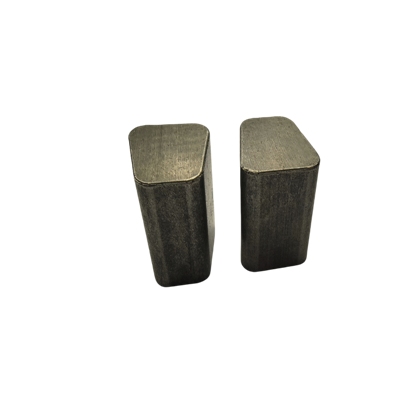
SmCo permanent magnets generally do not require surface treatment, and the surface is rough. The surface of the NdFeB permanent magnet is electroplated because it is easy to oxidize, and the appearance is brighter and more beautiful.
8. Application
NdFeB magnets are ideal for use in powerful electric motors and generators, or where miniaturization is the main driving force, Samarium Cobalt magnets are often used in heavy duty high temperature applications.