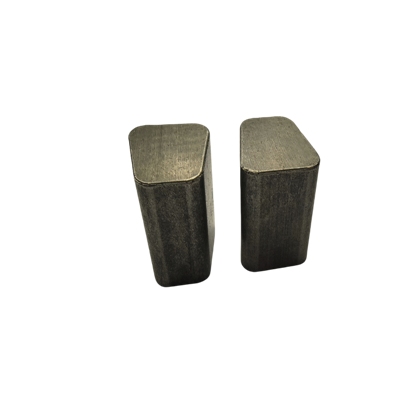
Steel or other materials can become permanent magnets because they are properly treated and processed to have the best internal inhomogeneity and maximum coercivity. Iron's crystal structure, internal stress and other inhomogeneities are small, and its coercivity is naturally small, so it does not require a strong magnetic field to magnetize or demagnetize it. Therefore, it cannot become a permanent magnet. Materials that are easy to magnetize and demagnetize are generally referred to as "soft" magnetic materials. "Soft" magnetic materials cannot be used as permanent magnets, iron is such a material
Just like the kind of magnetic steel rods you usually see. Permanent magnets are objects that can still retain a certain residual magnetization after the external magnetic field is removed. To make the residual magnetization of such an object to be zero and the magnetism to be completely eliminated, a reverse magnetic field must be added. The magnitude of the reverse magnetic field required to completely demagnetize the ferromagnetic substance is called the coercive force of the ferromagnetic substance. Both steel and iron are ferromagnetic, but their coercivity is different. Steel has a larger coercivity, while iron has a smaller coercivity. This is because in the process of steelmaking, carbon, tungsten, chromium and other elements are added to the iron to make carbon steel, tungsten steel, chromium steel, etc. The addition of carbon, tungsten, chromium and other elements causes the steel to have various inhomogeneities at room temperature, such as inhomogeneous crystal structure, inhomogeneous internal stress, and inhomogeneous magnetic strength. The unevenness of these physical properties increases the coercivity of steel. And the greater the degree of unevenness within a certain range, the greater the coercivity. However, these inhomogeneities are not the best state that the steel has or has achieved under any circumstances. In order to achieve the best state of the internal inhomogeneity of the steel, proper heat treatment or machining must be carried out. For example, when carbon steel is smelted, its magnetic properties are similar to that of ordinary iron; after it is quenched at high temperature, the non-uniformity grows rapidly and becomes a permanent magnet material. If the steel is slowly cooled from a high temperature, or the quenched steel is smelted at six or seven hundred degrees Celsius, its internal atoms have sufficient time to arrange into a stable structure, and various inhomogeneities are reduced, so correction The coercive force is then reduced, and it is no longer a permanent magnet material.