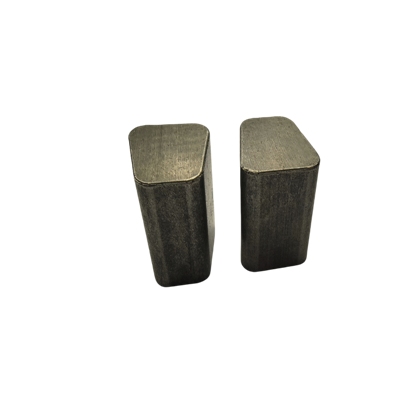
From the perspective of the development history of permanent magnet materials, the carbon steel used at the end of the 19th century had a magnetic energy product (BH) max (a physical quantity that measures the magnetic energy density stored in a permanent magnet) less than 1MGOe (megagauge), while foreign mass-produced Nd-Fe -B permanent magnet material, the magnetic energy product has reached more than 50MGOe. Over the past century, the remanence Br of the material has improved very little, and the improvement of the energy product is attributed to the improvement of the coercive force Hc. The improvement of coercivity is mainly due to the understanding of its nature and the discovery of high magnetocrystalline anisotropy compounds, as well as the progress of preparation technology.
At the beginning of the twentieth century, people mainly used carbon steel, tungsten steel, chromium steel and cobalt steel as permanent magnet materials. In the late 1930s, the successful development of AlNiCo permanent magnet materials made the large-scale application of permanent magnet materials possible. In the 1950s, the emergence of barium ferrite not only reduced the cost of permanent magnets, but also expanded the application range of permanent magnet materials to high-frequency fields. In the 1960s, the emergence of rare earth cobalt permanent magnets opened up a new era for the application of permanent magnets.
In 1967, Strnat of the University of Dayton in the United States successfully made SmCo5 permanent magnets by powder bonding, marking the arrival of the era of rare earth permanent magnets. So far, rare earth permanent magnets have experienced the first generation of SmCo5, the second generation of precipitation hardening type Sm2Co17, and the development of the third generation of Nd-Fe-B permanent magnet materials.
In addition, Cu-Ni-Fe, Fe-Co-Mo, Fe-Co-V, MnBi, A1MnC alloys, etc. have been used as permanent magnet materials in history. These alloys are rarely used in most occasions due to their low performance and low cost. And AlNiCo, FeCrCo, PtCo and other alloys are also used in some special occasions. At present, Ba and Sr ferrites are still the most used permanent magnet materials, but many of their applications are gradually being replaced by Nd-Fe-B materials. Moreover, the current output value of rare earth permanent magnet materials has greatly exceeded that of ferrite permanent magnet materials, and the production of rare earth permanent magnet materials has developed into a major industry.