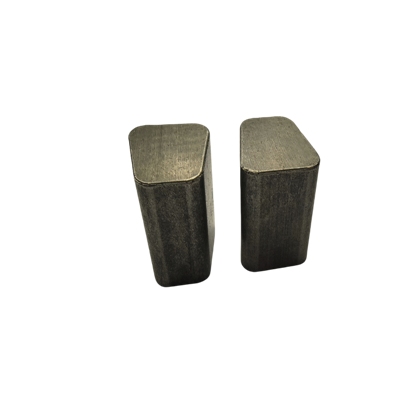
Due to different manufacturing processes, they are divided into two categories: sintered NdFeB magnets and bonded NdFeB magnets. The strong magnet coating of NdFeB magnets is generally plated with nickel, copper, chromium, gold, black zinc, blue and white zinc, epoxy resin glue, etc. Depending on the electroplating process, the color of the magnet surface will also be different, and the storage time will also vary.
1. Metal plating
1.1 Electroplated metal coating
Electroplating enterprise technology, also known as electrodeposition environment technology, is a process in which the cathode and anode form a loop in the electrolyte solution (plating solution), and the metal cations to be plated in the electrolyte solution are deposited on the surface of the cathode plating component. The plating solution formula of NdFeB electroplating metal coating is mostly obtained by improving the traditional plating solution formula. When electroplating metal coating on the surface of NdFeB magnets, the primary issue is how to reduce the corrosion of the magnet by the plating solution and prevent the plating solution from remaining in the cavity on the surface of the magnet. Therefore, the chemical composition of the plating solution needs to be adjusted to obtain a neutral plating solution and maintain appropriate activity and dissolution of the plating layer. The following is an introduction to some commonly used NdFeB electroplating processes.
From the perspective of cost, corrosion resistance and mass production, nickel plating on the surface of NdFeB magnets is an ideal and most widely used method. But there are also some shortcomings, such as corner effect, uneven thickness of each part, many defects, large porosity, etc. Ni electroplating on magnets is similar to ordinary electroplating processes, but the chemical composition of the plating solution needs to be improved. The process flow is as follows: super washing, water washing, pickling, water washing, super washing, water washing, activation, water washing, electroplating, water washing and drying. Cheng et al. studied the pulse nickel plating process and proposed the optimal pulse nickel plating process. Blackwood et al. found that the adhesion and corrosion resistance of nickel plating obtained from acidic plating solutions were significantly better than alkaline nickel plating. The organic nickel plating process developed by Japan's Jindong Company eliminates the inevitable traces in the electroplating of these metal surfaces. In the current application of NdFeB protection, zinc plating is the second largest process after nickel plating. Since the crystallization thickness of the electroplated zinc layer is thicker than that of the electroplated nickel layer, the corrosion resistance is worse than that of the electroplated nickel layer, but the passivation process can form protective films of various colors. The cost of electroplating zinc production and management is low. In the ordinary electroplating process, by adjusting the chemical composition of the plating solution and controlling the pH value, NdFeB can be electroplated directly on NdFeB. It has been used in industrial production, but improving the adhesion between the coating and the substrate is still a problem.
1.2 Alloy coating
Zinc-nickel alloy coating is widely used in industrial production because of its good corrosion resistance, low hydrogen embrittlement and high cost performance. From an electrochemical point of view, zinc-nickel alloy coatings belong to iron-iron pole coatings. Its stable potential is more positive than that of pure zinc coating, so in the electrochemical protection of NdFeB, its corrosion current is smaller than that of pure zinc coating. From the research on the corrosion products of zinc-nickel alloy coating, the nickel in the alloy coating can effectively inhibit the corrosion behavior reaction in China. The corrosion product ZnCl_24Zn(OH)_2 is denser, more stable and conductive than ZnO in the zinc coating. worse. The zinc-nickel alloy plating bath system mainly uses an alkaline zincate system and a weak acid chloride system. The first two methods have high decentralized management capabilities and are suitable for electroplating large and complex parts, but the current efficiency level is low. The latter has the advantages of high current efficiency, fast deposition speed, low hydrogen embrittlement but good dispersion. Zhang Xiuzhu studied the electroplating process of new iron alloys with low hydrogen embrittlement and obtained an alloy coating with a nickel content of 8.4% to 22.6%, with almost no hydrogen embrittlement problem.
Electroplated zinc-iron alloy is widely used in industrial fields because of its good corrosion resistance, plateability, weldability and high hardness. Compared with pure zinc coating, zinc-iron alloy coating has better corrosion resistance and lower cost than pure nickel and zinc-nickel alloy coating. It may have become a new direction for NdFeB surface protection for enterprises in the future. Zinc-iron alloy coating is based on the abnormal co-deposition mechanism of zinc and iron, in which Fe2 and Zn2 are deposited on the substrate simultaneously through discharge. Some stabilizers should be added to the plating solution to inhibit the oxidation of Fe2 to Fe3 and reduce Fe3 to Fe2 to stabilize the plating solution. A newly developed iron stabilizer suitable for nickel-iron sulfate alloy plating baths. This method can transform the Fe3 produced by the corrosion of NdFeB magnets in the initial plating solution of electroplating enterprises from impurity ions into socially useful ions, which facilitates the maintenance of the plating solution. At present, common zinc-iron alloy plating solutions are divided into chlorinated acid acid systems, neutral sulfate systems and alkaline zincate systems. In these management systems, how to reduce the corrosion of the plating solution on the surface of NdFeB magnets before metal ions are deposited through discharge, and how companies can make the Fe2 in the plating solution safer and more stable, are the keys to realizing NdFeB electroplating of zinc-iron alloys. .
Black zinc: The surface of the product is treated to black according to customer needs. In terms of electroplating, it is mainly to add a layer of black protective film through chemical processing based on hot-dip galvanizing. This film can also play a role in protecting the product. Improve corrosion resistance time and increase oxidation time. However, its surface is easily scratched and loses its protective effect. Very few people use it today, and most of them are replaced by epoxy resin. It is gray-black and mostly replaced by epoxy resin.
1.3 Vacuum ion aluminum plating Vacuum ion aluminizing technology is a surface treatment method that combines vacuum evaporation, ion implantation and weather deposition technology. Based on vacuum evaporation and plasma activation, the vapor of the thin film material is ionized in the glow discharge of inert gas, and then the substrate is bombarded and coated. This method is a dry plating technology, which can avoid defects such as residual wet plating solution in the gap between the magnets, corrosion of the magnet surface by the plating solution, and embrittlement of the coating due to hydrogen absorption by the magnet during electroplating. The bonding strength and corrosion resistance of the ion-plated aluminum layer are much higher than those of zinc and nickel plating. During the ion plating process, the bombardment of high-energy ions and atoms on the surface of the magnet can, to a certain extent, affect the injection of ions, causing a reaction between the metal compound and the magnet. The formation of a new phase not only improves the bonding strength of the coating, but also It also increases the coercivity of the magnet. The ion aluminizing process will not cause pollution to the social environment, nor will it damage the mechanical system performance of the magnet, and will even improve the fatigue performance of some related materials. In addition, the aluminum coating has good conductivity and beautiful appearance.
1.4 Electroless nickel-phosphorus alloy plating
Electroless Ni-P alloy plating technology is a method that uses a reducing agent to autocatalytically reduce the Ni-P coating on the surface of activated parts without adding current. Nickel-phosphorus plating uses nickel salt to reduce nickel ions under the action of hypophosphite, and hypophosphite decomposes phosphorus. The reduction reaction process can only be carried out under the action of different catalysts. Metals such as aluminum, nickel, cobalt, iron and their alloys have catalytic effects, so NdFeB magnets can be directly plated with nickel-phosphorus alloys. At the beginning of the reduction reaction, a nickel alloy coating can be obtained spontaneously and uniformly over the entire magnet due to the autocatalytic effect of nickel. In order to ensure quality, complexing agents, buffers, stabilizers, pH regulators, etc. Should be added during electroless plating. The nickel-phosphorus alloy coating has fewer pores, uniform thickness, high hardness, smooth surface, and good adhesion to the substrate. Coatings with a phosphorus content greater than 7% have an amorphous structure, no grain boundary defects, and high corrosion resistance.
1.5 copper: mostly occurs in the hardware industry. Very few people use it in the field of NdFeB magnets. Its appearance is light yellow. Very rarely used, appearance is light yellow
1.6 Chromium: Chromium electroplating is also relatively rare in the field. The cost of its electroplating process is very high and cannot be adopted by ordinary enterprises. However, its ability to release decay is very strong and it is difficult to react with other substances. Mainly used in areas with extremely strong pH. This is generally rarely chosen.
1.7 Gold: Most of the light yellow gold jewelry you see at some stalls on the street is electroplated gold or copper. Gold plating makes the surface of the product look as good as the core. It is generally used in the field of jewelry. It is also used as conductive components in some high-end luxury consumer electronics. For example, the conductive interface of wireless Bluetooth headsets with relatively high brand value uses gold plating.
2. Organic coating
2.1 Polymer coatings can be used for magnet surface protection in severely corrosive environments and applications requiring electrical insulation. The main research materials for NdFeB magnet polymer composite coatings are resins and organic bonded polymers, among which the most widely used is resin coating. This is because epoxy resin has very excellent water resistance, chemical resistance and adhesive properties, and develops its own sufficient hardness. In addition to epoxy resin, available resin coatings include polyacrylate, polyamide, polyimide, etc. Mixtures of these resins may also be used. The main contents of coating process research include spraying and electrophoresis. Cathodic electrophoresis coatings have high acid resistance, alkali resistance, solvent resistance, mechanical properties, especially adhesion. Before electrophoresis, zinc phosphate pretreatment is usually performed. Zinc phosphate is both an insulating layer and an anti-corrosion layer. Bonded magnets are easily oxidized in the air. The coating treatment can isolate the magnetic powder from oxygen or water in the air to prevent oxidation and rust. Cheng et al. applied a new type of resin material (bismaleimide resin) to the surface protection of NdFeB magnets, which has higher stability and lower moisture sensitivity than epoxy resin.
2.2Parylene is a new conformal coating material developed by the British Union Carbide Company in the mid-to-late 1960s. It is a paraxylene polymer. Rare earth NdFeB magnet hydromagnetic raw material is a strong magnetic material with excellent performance and one of the important raw materials for the miniaturization and ultra-miniaturization of micromotors. However, this kind of material is very unstable in the air. Larger materials usually use electroplating or epoxy resin autophoretic paint for protective coating. Small and medium-sized rare magnetic materials with a size of 1-5 mm, especially rings and cylinders. Shape-like earth magnetic materials can no longer achieve reliable protection and meet the application requirements through the above traditional methods. The combination of polyparalylene's unique production process and excellent properties enables it to fully coat small and medium-sized compact magnets without any weaknesses. The permanent magnet material coated with it can be immersed in sulfuric acid for 10 days. The above does not corrode. At present, almost all small and medium-sized magnetic materials in the world use parylene as the insulation layer and protective coating.
3.Conclusion
In summary, some progress has been made in surface protection of NdFeB. Good corrosion resistance has been achieved, which greatly promotes the further widespread application of NdFeB magnets. But there are different drawbacks for different protection working methods. For the electroplating process, improving coating adhesion and reducing hydrogen embrittlement are key technologies. Although the vacuum ion aluminizing method has good adhesion and corrosion resistance, the coating is prone to cracking due to hydrogen absorption by the magnet. Although electroless nickel-phosphorus alloy plating can improve the plating ability and coating hardness of parts with complex shapes, it is difficult to maintain the complex process at that time. However, although organic coatings have good adhesion and corrosion resistance, their high temperature resistance is extremely poor. Therefore, there is still much room for improvement in NdFeB surface protection technology. Therefore, to develop or improve NdFeB surface protection technology, the following conditions should be met at the same time: little or no hydrogen embrittlement during the coating process; (2) the coating should have good substrate adhesion; (3) the coating surface must be dense , no micropores or cracks, the coating should have low permeability, and the coating should have certain temperature stability.