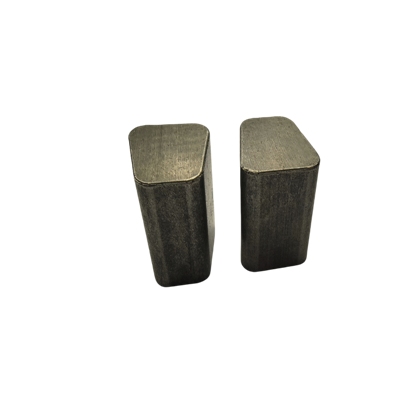
NdFeB magnet is a rare earth permanent magnet alloy material. It has the advantages of high magnetic performance and high cost performance, so it is widely used in electroacoustic, motor, aerospace, medical and other fields. Today I will show you the density knowledge of NdFeB magnets. The density of magnets is one of the most important reference indicators for evaluating the quality of magnetic materials. For standardized production, density control is very critical. The physical properties of NdFeB are related to its chemical composition. The permanent magnet alloy is composed of NdFeB matrix and additives. The density of NdFeB is related to the composition of the material. The density of the NdFeB matrix is 7.5-7.7g/cm2, and the density will also vary depending on the type and amount of additives.
The density test of the material can directly judge whether the product quality is qualified or not. If the density does not meet the requirements, it will directly affect the overall quality of the product. Therefore, the structure and quality of solid materials can be quickly and routinely characterized by a density meter, such as the density of magnetic materials, solids, ceramics, minerals, metals, rubber, plastics, precious metals, ores, jade, powder metallurgy materials, etc.
Test procedures for non-absorbent samples:

1. Put the sample into the measuring table, measure the weight in the air, and press the Enter key to memorize.
2. Completely immerse the sample in water, measure the weight in the water, press the Enter key to remember, and directly display the density value.
Common measurement methods for absorbent products:
Silicone oil method, sealing wax method:
1. Silicone oil method
Use the solution supplementary measurement method to measure the green density of magnetic materials with silicone oil. The silicone oil method is not suitable for every magnetic material. Some materials will disintegrate and powder will fall when placed in the solution. This kind of magnetic material green embryo is not suitable for measurement. Measurement steps of silicone oil method:
1; First set the machine solution compensation to the silicone oil density
2; First place the product on the instrument and measure the weight of the product in the air.
3. Place the green embryo product in silicone oil and measure the weight in the silicone oil. It takes 4S-5S stabilization time in the silicone oil. After stabilization, press the MODE key to directly display the density value.
2. Sealing wax method
The sealing wax method takes a long time to measure and requires patience. It is generally used in schools, research institutes and other units.
1; Put the sample into the measuring platform, measure the weight in the air, and press the M key to remember.
2; After sealing the sample with wax, place it on the measuring platform, measure the weight in the air, and press the M key to remember.
3; Put the sample into water after sealing with wax, measure the weight in the water, press the M key to remember, and the density value will be displayed directly.
troubleshooting
(1) Unstable weight:
Troubleshooting method: Remove the measuring table and sink and check if there are any foreign objects or water drops under the support table. If there are foreign objects or water droplets, please remove the foreign objects or wipe the water droplets clean first.
(2) If the screen displays ---------- or -ERROR-
Troubleshooting method: Press first, and try to see if it can be reset to zero stably. If it does not return to zero, first remove the objects on the measuring platform, and then contact the relevant personnel of the supplier to come to repair.
(3) If a fault occurs that cannot be eliminated by yourself, do not open the machine without authorization, and contact the relevant personnel of the supplier for repairs in time.
(4) If the measured density value is always a numerical value, or the measured density always displays 0.000, please set the temperature compensation to 25 and the solution compensation to 1
5. The following display information indicates some common faults:
A -------- indicates that the electronic balance cannot obtain a stable reading.
B If 8.8.8.8.8.8 cannot convert 0.00g/0.000g. This means that the zero point has drifted. Press the zero key to display 0.00g/0.000g. If not, please recalibrate.
Generally speaking, the density of NdFeB is mainly affected by elemental composition and crystallinity. Compared with sintered materials, the density of hot-pressed materials is higher, and its density can reach 7.2~7.6g/cm3, while the density of sintered materials mainly depends on the heat treatment process, and the density of sintered materials is generally 6.0-7.0gcm3.
The theoretical density of NdFeB compounds is 7.62g/cm³, and the density of sintered NdFeB magnets is 7.5g/cm³.
With the development of production technology, the density of NdFeB magnets will also change, which will affect the overall magnetic properties. The density of NdFeB is related to the material composition. When small amounts of elements such as dysprosium and terbium are added, the density may become higher.
For example: N35 grade, density 7.5g/cm³, N50 grade, density 7.55g/cm³, N42SH, density 7.6g/cm³, N55 grade, density 7.65g/cm³
There are many kinds of magnetic materials, such as permanent magnet ferrite, high temperature resistant samarium cobalt magnet, alnico alloy or bonded magnet. The density varies greatly depending on the molding method or material. The densities of several common magnetic materials now are:
1. Sintered NdFeB, density is about 7.5g/cm³
2. Bonded NdFeB, density is about 6g/cm³
3. Samarium cobalt magnet, density about 8.4g/cm³
4. Alnico magnet, density is about 7.3g/cm³
5. Sintered ferrite, density is about 4.9g/cm³
6. Injection molded ferrite, density about 3.8g/cm³
7. Injection molded NdFeB, density is about 5.0g/cm³