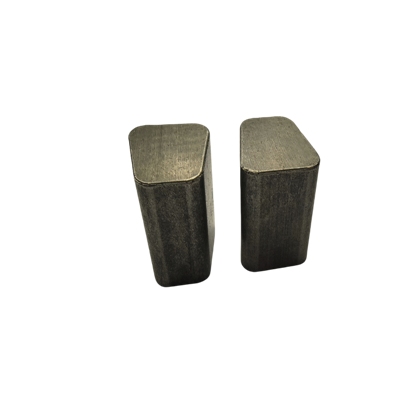
The reason why NdFeB will demagnetize in high temperature environment is determined by its own physical structure. The reason why a magnet can generate a magnetic field is because the electrons carried by the substance itself rotate around the atom in accordance with the direction, thereby generating a magnetic field force, which in turn affects the surrounding related affairs. However, the rotation of electrons around atoms in a predetermined direction is also limited by temperature conditions. Different magnetic materials can withstand different temperatures. If the temperature is too high, electrons will deviate from the original orbit, causing chaos. The local magnetic field of the material will be disrupted, resulting in demagnetization.
How to improve the high temperature demagnetization of NdFeB
Solution:
Improve the high temperature resistance of bonded NdFeB permanent magnets: By adding alloying element Co to replace Fe in Nd2Fe14B phase, the Tc of the magnet can be increased. However, excessive Co not only increases the cost of materials, but also reduces the residual magnetic induction and maximum energy product of permanent magnet materials.
The method for improving the temperature resistance of sintered NdFeB magnets is: heavy rare earth Tb and Dy can significantly increase the anisotropy field of NdFeB magnets, adding heavy rare earth (HRE) elements, such as Dy and Tb, to replace 2:14: Nd in phase 1 forms a (HRE, Nd)2Fe14B phase (HRE = Dy, Tb) with a higher magnetic anisotropy field. Due to the antiferromagnetic coupling between heavy rare earth atoms and Fe atoms, the addition of heavy rare earth This causes a decrease in the remanence and energy product of the magnet and increases the cost.
The grain boundary diffusion technology that appeared in the early 21st century is a major progress in the field of rare earth permanent magnet manufacturing. It infiltrates the heavy rare earth elements or rare earth alloys into the magnet in the form of grain boundary diffusion, while effectively increasing the coercive force of the magnet, it greatly reduces the content of heavy rare earths and improves the cost performance.
According to the coercive force mechanism of sintered NdFeB permanent magnets, the reverse magnetization domain is first formed on the surface of the grain, so the grain surface is the weakest link in the magnet, and increasing the anisotropy field on the grain surface can delay the formation of the reverse magnetization domain Formed, thereby increasing the coercive force of the entire magnet. Grain boundary diffusion initially uses the simple substance or compound of heavy rare earth elements Tb and Dy as a diffusing agent. Through diffusion heat treatment, the heavy rare earth enters the magnet from the surface of the magnet along the grain boundary, and distributes on the grain boundary and grain surface to improve the NdFeB magnet. Tenacious. The temperature of the diffusion treatment is generally higher than the melting point of the rare earth-rich phase at the grain boundary in the Nd-Fe-B magnet, and the liquid rare-earth-rich phase is conducive to the rapid diffusion of elements along the grain boundary. Grain boundary diffusion distributes heavy rare earths in the grain boundaries and rarely enters the grains, so that the coercive force can be increased while the adverse effects of heavy rare earths on remanence can be reduced, and excellent comprehensive magnetic properties can be obtained. In addition, studies have shown that when the motor and generator are working, the high temperature environment makes the surface of the magnet preferentially demagnetized, so the surface layer of the magnet should have a higher coercive force than the core. The process of grain boundary diffusion can produce magnets with uneven distribution of heavy rare earths on a macroscopic scale. The surface layer of the magnet is enriched with heavy rare earths to provide high coercive force, while the core of the magnet has only a small amount of heavy rare earths to maintain high remanence. Therefore, the grain boundary diffusion technology not only enables the more effective utilization of heavy rare earths, but also achieves high coercive force and high magnetic energy product at the same time. In current industrial production, the thickness of most magnets treated with grain boundary diffusion is less than 4 mm, and rarely more than 8 mm.