2009 was the ``first year of electric vehicles.'' An internal combustion engine obtains mechanical energy (rotational power) through a chemical reaction called combustion, but a motor converts electrical energy directly into mechanical energy. In the case of an EV (electric vehicle) motor, electricity flows through the stator fixed to the case, and the rotor, which is a rotating body, receives the electricity as rotational energy.
If you look at the rotation of a motor in very short periods of time, you will see that the direction of the magnetic force on the stator side, where the current flows, is constantly changing. The rotor side repeats the action of being "pulled", then "separated", and then "pulled" again. This is because this method is suitable for obtaining rotational motion. Only one side needs to rotate. In other words, the stator must be made of a material whose magnetization reverses when the direction of the current is reversed (a soft magnetic material), and the rotor must be made of a material whose magnetization continues to be maintained even when the direction of the current changes (a hard magnetic material). materials) are required. For this reason, motors use electromagnetic steel plates for the outer stator and permanent magnets for the rotating rotor.
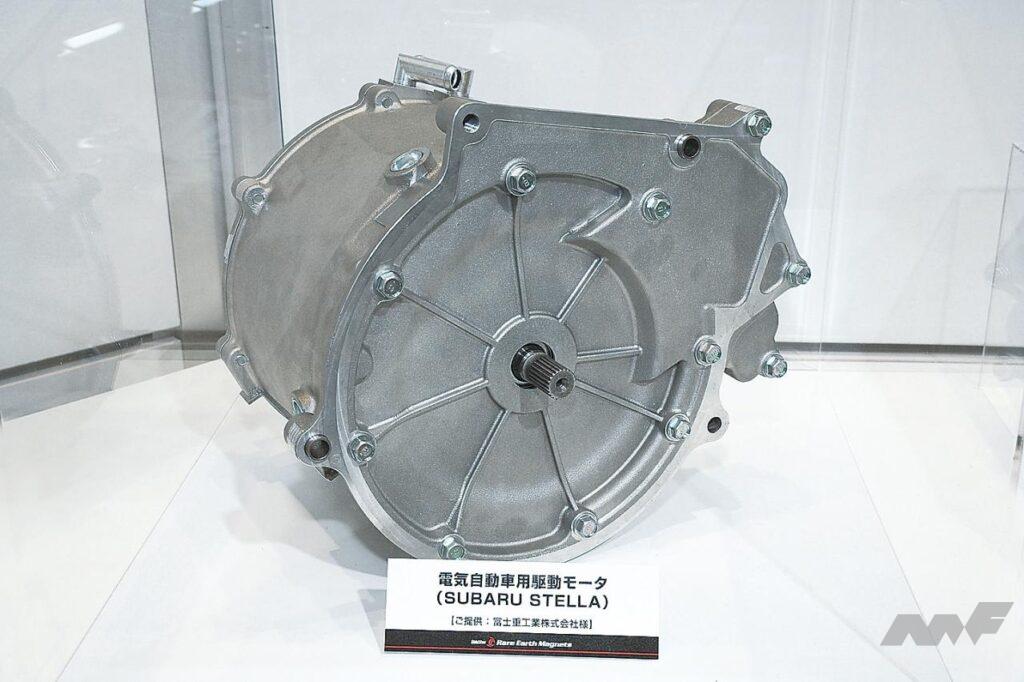
Fuji Heavy Industries plug-in Stella motor. It shares the same design as the Mitsubishi i-MiEV, but the detailed specifications are different. The Ryobi aluminum die-cast casing is double layered, with cooling water passages molded inside. The know-how also includes how to insert the core and how to cast.
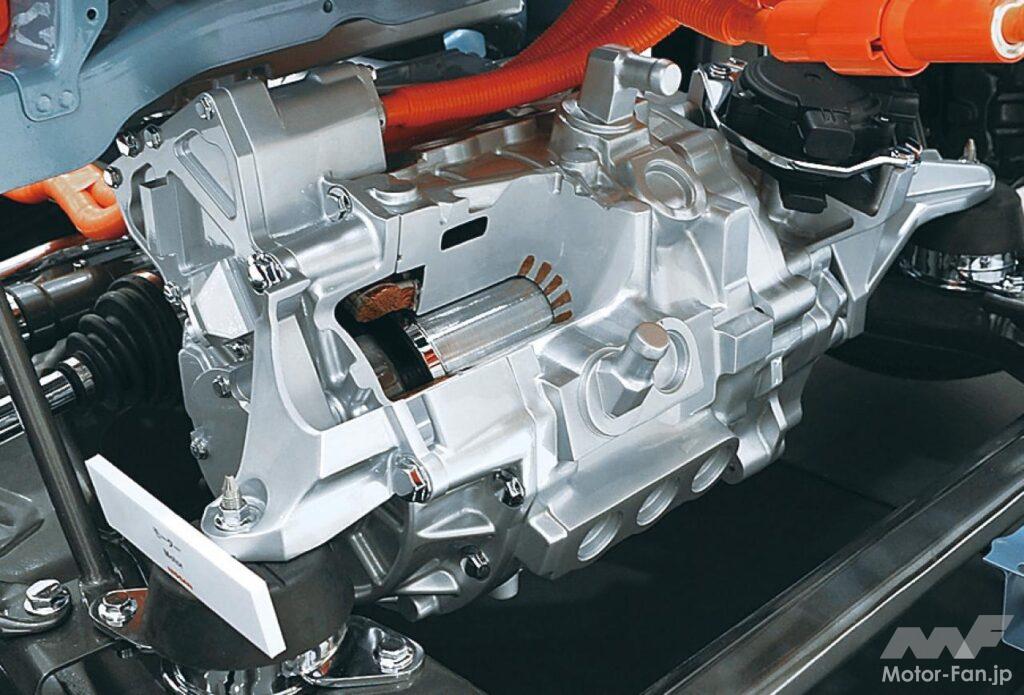
Motor part of Nissan Leaf. As you can see from the size of the mount with its arms extended from side to side, the motor, which is a block of metal, is heavier than it appears. As with internal combustion engines, the reason why a 1% efficiency improvement is required is to reduce this weight as much as possible.
Motors for EVs are extremely high-performance and expensive. Moreover, it is required to be lightweight and highly efficient. According to motor manufacturers, EV motors have "insane performance requirements."
Normally, motors are often used at a nearly constant rotational speed. The rotation of a train's motor changes as the train starts and stops, but the acceleration is constant and the deceleration is also constant. Speeds are specified between stations, and gradients are also known. Therefore, you can respond by driving as programmed. However, for EVs running on general roads, there is no set number of revolutions after the number of seconds after starting. Even on the same road, the motor's work changes depending on the traffic situation. A motor whose rotation is constantly changing cannot be used in normal applications. That's why it's insane.
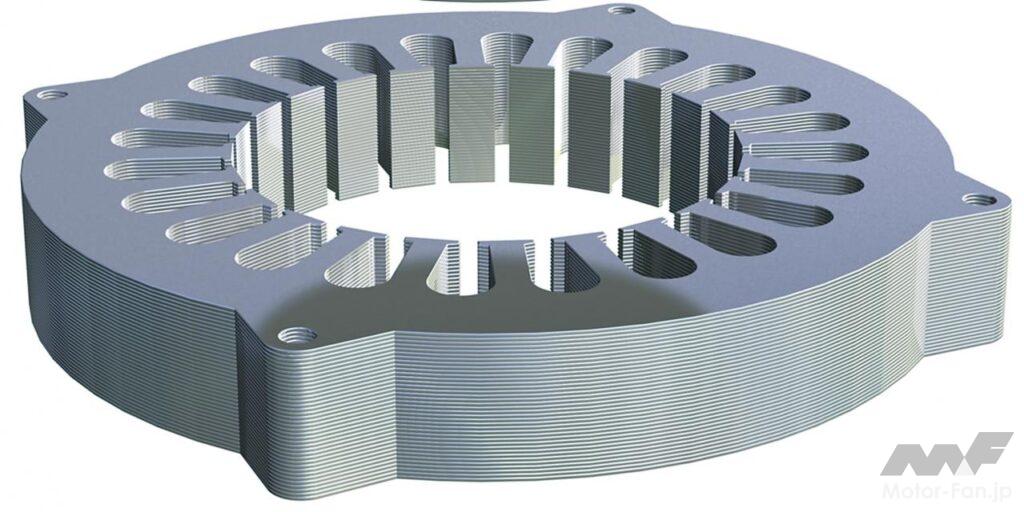 The stator is formed by stacking many ultra-thin electromagnetic steel plates. The thinner it is, the more eddy current loss can be suppressed, but a certain degree of thickness is required to maintain shape accuracy. The balance depends on the know-how of each steel manufacturer. (ILLUST: Toshinao Kumagai)
In order to handle this rotational fluctuation smoothly, the stator side must instantly switch magnetization, but the next instant a large force must be transferred to the rotor side. The stator requires a material that is highly efficient (low loss) and whose magnetization can be easily reversed. This is electrical steel sheet, which is a soft magnetic material. In EVs, electromagnetic steel sheets with a thickness of 0.3 to 0.5 mm are stacked to form a thick plate. It's to suppress it. The surfaces of the ultra-thin electrical steel plates are coated and insulated from each other. This structure reduces eddy current loss.
On the other hand, permanent magnets are used on the rotor side, which receives current and generates rotational force, but for EVs, which have large rotational fluctuations and strict requirements for "sudden deceleration" and "sudden acceleration," as well as high rotation and large torque. Regarding motors, firstly, magnet torque type motors with magnets arranged around the rotor are not suitable. For hybrid vehicles, there is a magnetic torque type, but for pure EVs, a combination of magnetic torque and reactance torque is used, with magnets arranged so that the magnetic field of the permanent magnet becomes stronger at regular intervals around the rotor facing the stator surface. It is a type motor.
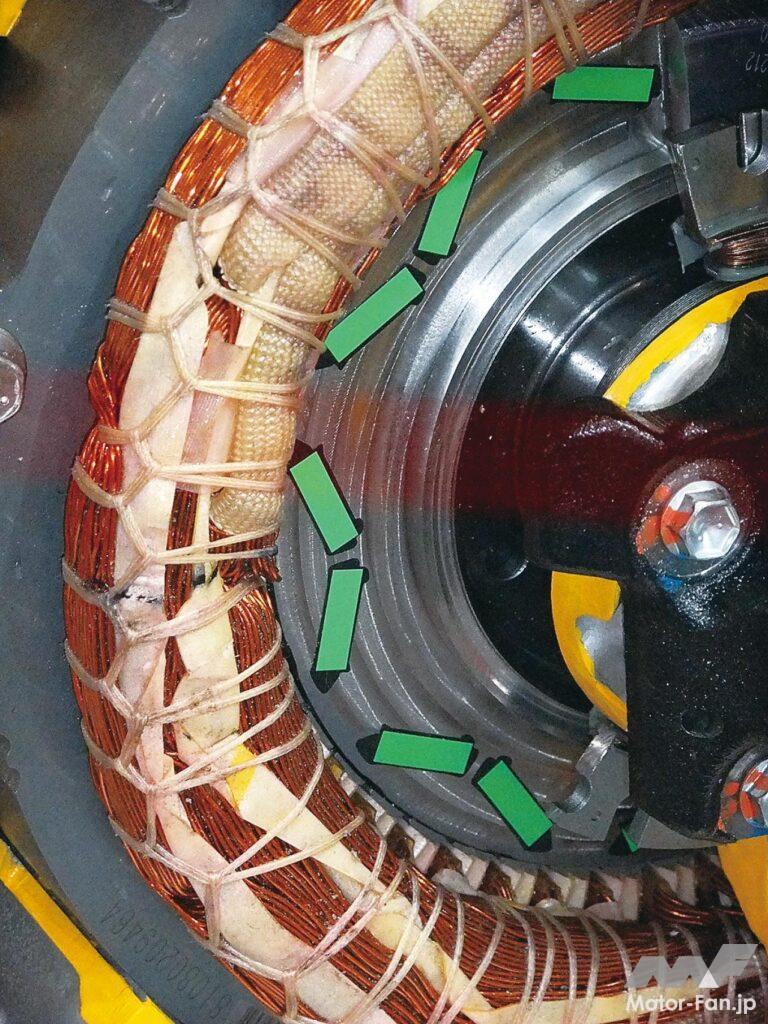
Powerful rare earth magnets embedded in the rotor. The way they are arranged affects motor performance. Placing a magnet near the outer periphery will increase the magnetic torque, but that alone is not suitable for EVs. The magnets are arranged diagonally to utilize reactance torque (which has a different phase from the magnet torque).
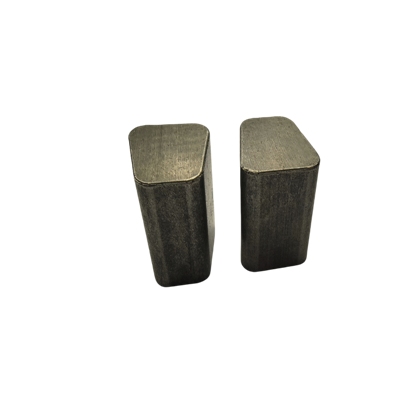
In the photo above, green permanent magnets are embedded in the rotor, and the placement of these magnets is the know-how. Moreover, the magnets used are rare earth magnets whose components include neodymium, iron, and boron, which are the strongest among permanent magnets. Dysprosium is also added to suppress thermal demagnetization, which weakens the magnetic force due to the heat of high rotation. It is said that adding 1% dysprosium can improve thermal demagnetization by about 15°C, and such high-performance magnets are essential for EV motors.
Increasing the motor output is often done in electric vehicles, but one way to increase the output with the same motor is to increase the rotation speed. However, if the rotation is increased, thermal demagnetization is likely to occur. Also, the higher the rotation, the more difficult it becomes to manage the small gap between the rotor and stator. Machining precision is required for electromagnetic steel sheets.
The technology for mass producing high-performance motors is extremely advanced. It requires not only design know-how but also help with materials. We also need help with the manufacturing process. For this reason, many steel manufacturers provide electrical steel sheets with processing technology included. In this way, motor performance has improved dramatically. The casing of the motor is made of aluminum alloy, which is a non-magnetic material. This shape design and processing is also a mass of know-how.