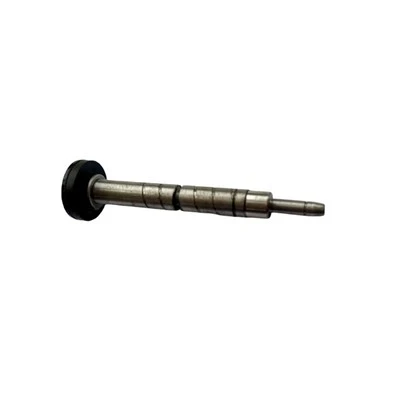
High-speed motors save materials because of their high speed, high power density, and small geometric dimensions; they have small moments of inertia and fast dynamic response; they can be directly connected to the load, eliminating the need for traditional transmission devices, reducing noise and improving system efficiency; high-speed motor rotation Under the current situation, the reliability requirements of the motor rotor are quite high. In summary, the following points need to be paid attention to:
1. Requirements for dynamic balance of high-speed motor rotors: The dynamic balance of permanent magnet motor rotors is divided into two types: de-weighting method and weight-increasing method: the factors affecting the dynamic balance and unbalance of motor rotors include rotor quality, speed, rotor structure, and rotor assembly process, etc. ;The calculation of the allowable unbalance of the rotor can refer to the following formula: e=M×G×(60/(2×π×r×n))×10³ M: rotor mass G: rotor balance accuracy grade R: rotor balance radius N: The maximum working speed of the rotor. The definition of rotor balance accuracy grade G can refer to the corresponding standards, such as ISO 1940/GB 9239. The motor rotor is generally specially designed with a weight-removing structure. The materials are mainly copper, stainless steel, aluminum, or plastic, which are assembled at both ends of the rotor magnets . The corresponding structure design and material selection can be carried out according to the size of the weight removal.
2. Requirements for the concentricity of the rotor part of the motor:
The accuracy of the shaft, the concentricity of the rotor magnets, and the superimposed concentricity of the rotor after assembly all need to meet the accuracy requirements of the motor. (Assembly tolerance of shaft and ring magnets or other accessories)
3. Rotor Strength Analysis
The rotor of the motor under high rotation will generate high centrifugal force. If the mechanical strength of the rotor magnetic ring cannot meet the requirements, the centrifugal force will break the ring magnets under the driving action of the motor stator. This has to consider the protection of the high-speed motor rotor ring magnets . It is very common in high-speed motors to use a sheath to protect the rotor ring magnets . The sheath is generally made of non-magnetic alloy steel or carbon fiber.
Hot Tags: high speed motor rotor, China high speed motor rotor manufacturers, suppliers, factory, strongest rare earth magnets, rare earth permanent magnet, permanent magnet bar, permanent magnet dc, large permanent magnet, arc ferrite magnet
MAGNETIC AND PHYSICAL PROPERTIES OF BONDED MOLDING NdFeB MAGNET
| Grade | Bonded Molding | |||||||||||||||
| HMG-2 | HMG-3 | HMG-4 | HMG-6 | HMG-7B | HMG-8L | HMG-8H | HMG-8HD | HMG-10A | HMG-10L | HMG-10H | HMG-11L | HMG-11H | HMG-12H | HMG-12L | HMG-13L | |
| Br (KGs) | 3.0-4.0 | 3.5-4.5 | 4.5-5.0 | 5.0-6.0 | 6.0-6.5 | 6.3-6.7 | 6.2-6.8 | 6.2-6.6 | 6.5-7.2 | 7.0-7.5 | 6.5-7.0 | 7.0-7.5 | 6.5-7.2 | 7.2-7.85 | 7.2-7.85 | 7.8-8.3 |
| Residual lnduction (T) | 0.3-0.4 | 0.35-0.45 | 0.45-0.5 | 0.5-0.6 | 0.60-0.65 | 0.63-0.67 | 0.62-0.68 | 0.62-0.66 | 0.65-0.72 | 0.7-0.75 | 0.65-0.70 | 0.70-0.75 | 0.65-0.72 | 0.72-0.785 | 0.72-0.785 | 0.78-0.83 |
| (Hcb) (Koe) | 2.4-3.2 | 2.8-3.2 | 3.0-4.0 | 4.0-4.5 | 4.2-5.0 | 4.8-5.6 | 5.5-6.5 | 5.0-6.0 | 5.3-6.0 | 5.0-5.5 | 5.5-5.8 | 5.0-5.5 | 5.3-6.0 | 5.0-6.0 | 5.0-6.0 | 5.0-6.0 |
| Coercive Force (kA/m) | 192-256 | 224-256 | 240-320 | 320-360 | 336-400 | 384-448 | 440-520 | 400-480 | 424-480 | 400-440 | 440-464 | 400-440 | 424-480 | 400-480 | 400-480 | 400-480 |
| (Hci) (Koe) | 6.0-8.0 | 6.0-8.0 | 7.0-9.0 | 7.0-9.0 | 8.0-10.0 | 8.0-10.0 | 12.0-16.0 | 11.0-14.0 | 8.0-10.0 | 6.5-8.0 | 9.0-11.5 | 6.5-8.0 | 8.5-10.0 | 8.0-10.0 | 6.5-8.0 | 6.0-8.0 |
| Intrinsic Coercive Force(kA/m) | 480-640 | 480-640 | 560-720 | 560-720 | 640-800 | 640-800 | 960-1280 | 880-1120 | 640-800 | 520-640 | 720-920 | 520-640 | 680-800 | 640-800 | 520-640 | 480-640 |
| (BH)max (MGOe) | 2.0-3.0 | 2.5-3.5 | 4.0-5.5 | 6.0-7.0 | 7.0-8.0 | 8.0-9.0 | 8.0-9.0 | 8.0-9.0 | 9.0-10.0 | 9.5-10.5 | 9.0-10.0 | 10.0-11.0 | 9.7-11.0 | 10.0-12.0 | 10.0-12.0 | 11.0-13.0 |
| Max.Energy Product (kJ/m3) | 16-24 | 20-28 | 32-44 | 48-56 | 56-64 | 64-72 | 64-72 | 64-72 | 72-80 | 76-84 | 72-80 | 80-88 | 77.6-88 | 80-96 | 80-96 | 88-104 |
| μRecoll (μH/m) Permeabilily |
1.2 | 1.2 | 1.2 | 1.2 | 1.2 | 1.2 | 1.2 | 1.2 | 1.2 | 1.2 | 1.2 | 1.2 | 1.2 | 1.2 | 1.2 | 1.2 |
| Temperature Coefficient of B(%/℃) |
-0.11 | -0.11 | -0.11 | -0.11 | -0.11 | -0.12 | -0.08 | -0.08 | -0.11 | -0.11 | -0.10 | -0.12 | -0.10 | -0.10 | -0.12 | -0.12 |
| Tc Curie Temperature(℃) | 350 | 320 | 350 | 350 | 350 | 350 | 350 | 350 | 350 | 350 | 350 | 320 | 320 | 320 | 320 | 320 |
| Baturation(KA/m) Magnetizing Force(Koe) |
>1600 | >1592 | >1600 | >1600 | >1600 | >2400 | >2400 | >2400 | >1600 | >1600 | >1600 | >1600 | >1600 | >1600 | >1600 | >1600 |
| >20 | >20 | >20 | >20 | >20 | >30 | >31 | >31 | >20 | >20 | >20 | >20 | >20 | >20 | >20 | >20 | |
| Max.Operating Temperature(℃) | 160 | 160 | 160 | 160 | 160 | 160 | 160 | 180 | 160 | 160 | 160 | 160 | 160 | 160 | 150 | 150 |
| Density (g/cm3) | 4.5-5.0 | 5.0-5.5 | 5.2-5.7 | 5.5-6.0 | 5.4-5.9 | 5.7-6.1 | 5.7-6.2 | 5.7-6.2 | 5.9-6.2 | 5.9-6.2 | 5.9-6.2 | 5.9-6.2 | 5.9-6.2 | 6.0-6.3 | 6.0-6.3 | 6.1-6.4 |